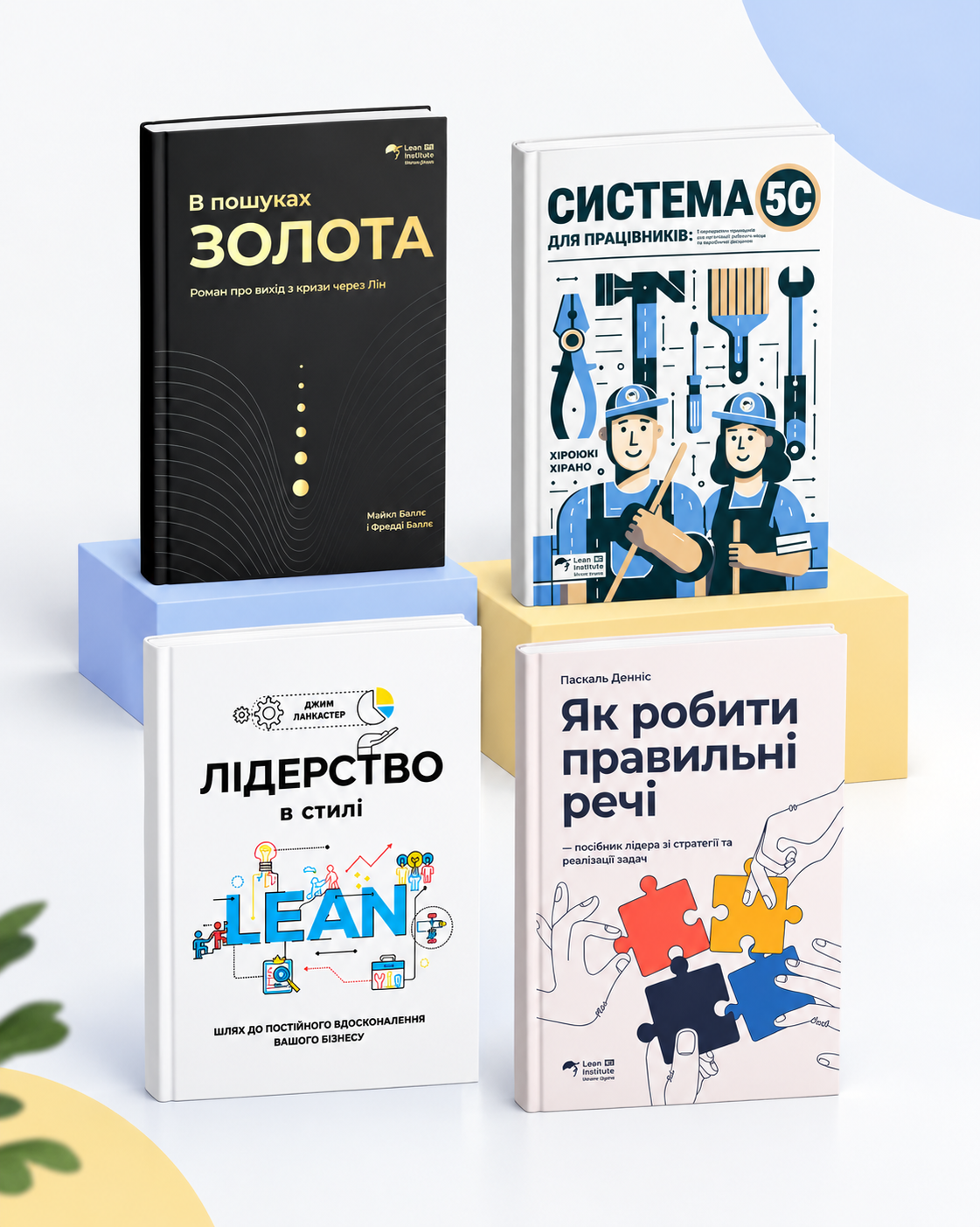
Complete Lean Library in Ukrainian
Джон Шук, Джим Ланкастер, Майк Ротер, Крістоф Розер, Паскаль Денніс, Mike Balle, Freddie Ballé, Hiroyuki Hirano, Fabrice Bernhard
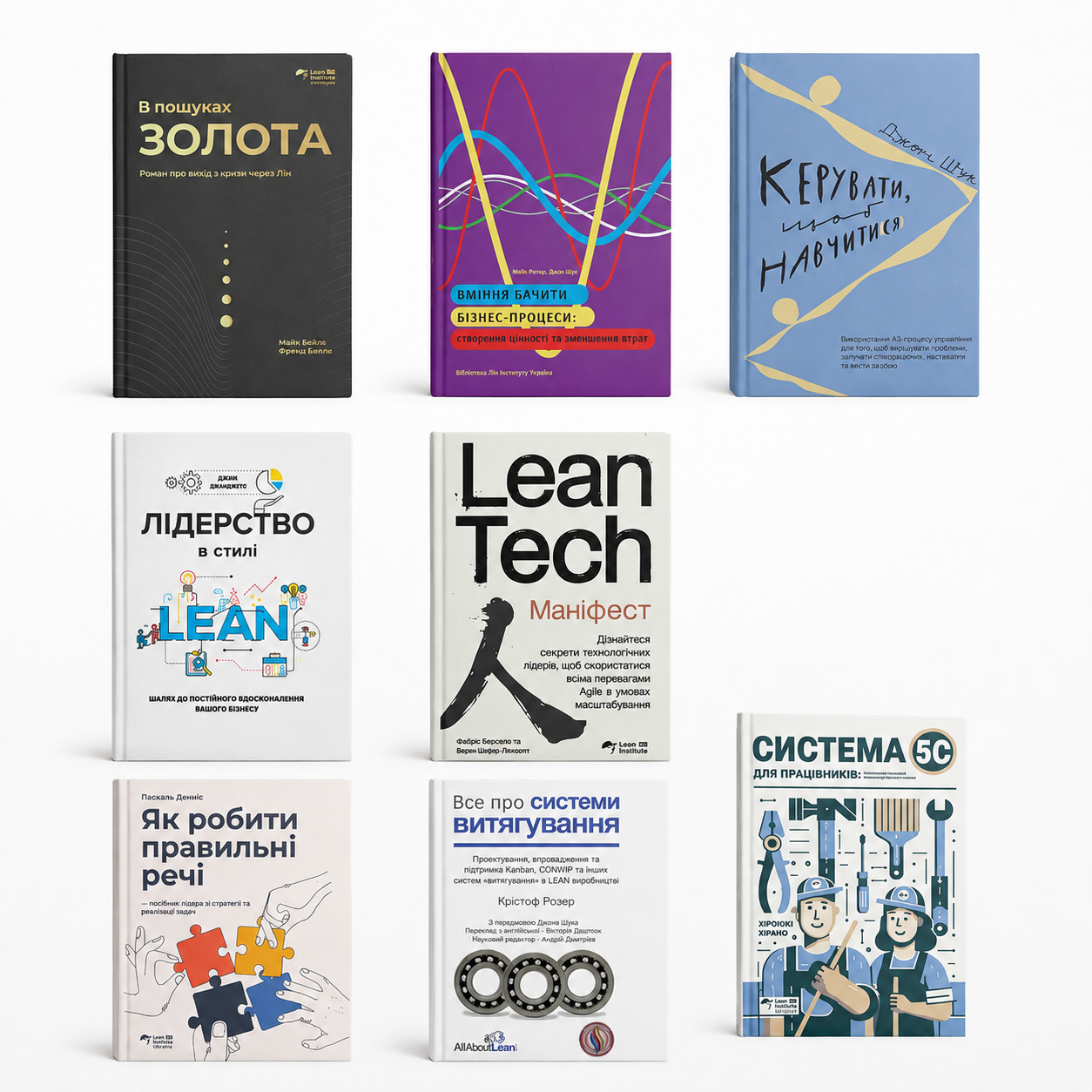
Complete Lean Library in Ukrainian
Джон Шук, Джим Ланкастер, Майк Ротер, Крістоф Розер, Паскаль Денніс, Mike Balle, Freddie Ballé, Hiroyuki Hirano, Fabrice Bernhard
In stock
3700 ₴


Ukrainian
including a 10% discount
A comprehensive collection of essential Lean books in Ukrainian — from strategy deployment, leadership, and a culture of continuous improvement to flow, quality, inventory, and digital transformation.
This library provides a holistic understanding of Lean thinking and practical tools for implementing change in manufacturing, service, and technology companies.
For leaders, teams, and practitioners who want not just to read about Lean, but to build systems that consistently create value.
- “All About Pull Production” — Christoph Roser
A comprehensive practical guide to pull systems that explains in detail the principles of managing flow, inventory, and supply chains. The book is a working tool for improving production processes and will be useful to both beginners and experienced Lean practitioners.
The author brings together methodology and practical cases from around the world, addressing one of the most difficult business questions: how to actually implement pull systems rather than merely discuss them in theory. The book fills a gap in practical materials on this topic and shows that a pull system is not an abstract concept but a clear and achievable management tool for companies of any size and in any industry.
- “Learning to See” — Mike Rother, John Shook
This is one of the essential works on Lean thinking, equally valuable for manufacturing and service companies. At the heart of the book is the concept of customer value and the ability to see exactly how it is created through processes.
Drawing on Toyota Motor Corporation’s experience, Mike Rother and John Shook offer a practical approach to value-stream analysis. The book helps readers understand how processes actually work, where waste occurs, and how to eliminate it systematically instead of relying on local, temporary improvements.
- “The Lean Tech Manifesto” — Fabrice Bernhard, Benoît Charles-Lavauzelle
The first book to combine Lean and digital approaches, offering a practical framework for building an Agile culture in technology organizations. It shows how to create value flow, empower teams, improve process quality, and accelerate delivery without sacrificing innovation.
The authors, leaders of the international consulting company Theodo, demonstrate how to combine Lean thinking with the speed and scale of technology to create more value with less waste. The book will be useful to product managers, tech leads, executives, and C-level leaders looking for a systematic approach to scaling a business without losing Agile flexibility.
This book is not dry theory, but a vivid story of change told by a practicing leader who implemented Lean in his own company. Jim Lancaster, CEO of Lantech, describes his business transformation in detail: from traditional management to a systematic Lean approach in which every daily step leads to sustainable improvement. The author presents eight clear steps that help organizations move from occasional improvements to a permanent, continuous process that delivers real results. Practical examples and real cases make the book valuable for anyone who wants not only to understand Lean but also to apply it in business.
The set includes:
- “Managing to Learn” — John Shook
The book reveals the thinking behind Lean management and Lean leadership and shows how managers use the A3 process to teach teams to solve problems and take responsibility.
The author explains that sustainable results from Lean tools are possible only when a manager’s way of thinking changes: from command-and-control to management through dialogue, learning, and root-cause analysis. In the book, A3 is presented not as a reporting form but as a tool for thinking, developing people, and building a system.
The material is presented as a story: a young manager learns the Lean approach through real problems, while a mentor explains the logic behind decisions and the leadership insights involved. This format clearly demonstrates how a culture of responsibility and continuous learning develops within an organization.
- “The Gold Mine: A Novel of Lean Turnaround” — M. Ballé, F. Ballé
This book introduces key Lean principles — from flow, pull, kanban, and 5S to less obvious but critically important tools such as jidoka and heijunka. The authors, leading Lean consultants in the automotive industry, show the transformation of a company on the brink of bankruptcy, combining technical solutions with the human challenges of leadership. Complex processes are presented in an accessible way, with humor and emotional tension, allowing readers to experience the transformation alongside the team.
- “5S for Operators: 5 Pillars of the Visual Workplace” — Hiroyuki Hirano
This practical guide shows how to create an efficient, orderly, and safe workplace. It clearly explains how the five 5S principles — sort, set in order, shine, standardize, and sustain — can transform the work environment and eliminate waste. Practical advice, visual examples, and team-engagement tools make the book useful for manufacturing, offices, and virtually any workplace.
- “Getting the Right Things Done” — Pascal Dennis
This book introduces Hoshin Kanri, the Japanese method of strategy deployment that underpinned the development of some of the world’s most successful manufacturing companies and is now used by businesses worldwide to achieve systematic growth.
Told as an accessible story, the book explains complex principles of strategic planning step by step. Through examples, diagrams, and cases, readers experience a company’s transformation from the inside. It is a practical guide for leaders, filled with tools, mental models, and answers to key management questions. The book helps readers understand how to deploy strategy, what kind of management it requires, and how implementation should feel in daily processes, leaving a clear sense of: “I understand what to do next.”.
Characteristics
Lean Leadership: A Path to Continuous Improvement in Your Business
Jim Lancaster
Getting the Right Things Done: A Leader's Guide to Planning and Execution
Pascal Dennis
The Gold Mine: A Novel of Lean Turnaround
M. Ballé, F. Ballé
5S for Operators: 5 Pillars of the Visual Workplace
Hiroyuki Hirano
All About Pull Systems
Christoph Roser
Learning to See
Mike Rother, John Shook
Managing to Learn
John Shook
The Lean Tech Manifesto
Fabrice Bernhard, Benoît Charles-Lavauzelle
Reviews
Leave a reviewThere are no reviews yet.
No reviews yet